Photo Gallery
Then & Now
A historical photograph of Holy Trinity Church, alongside its condition today. Click any photo below to view it full size.
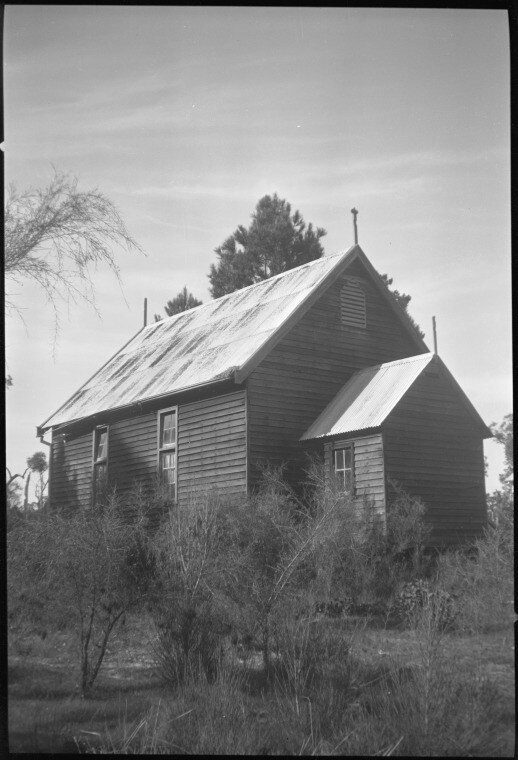
Then: historical photograph
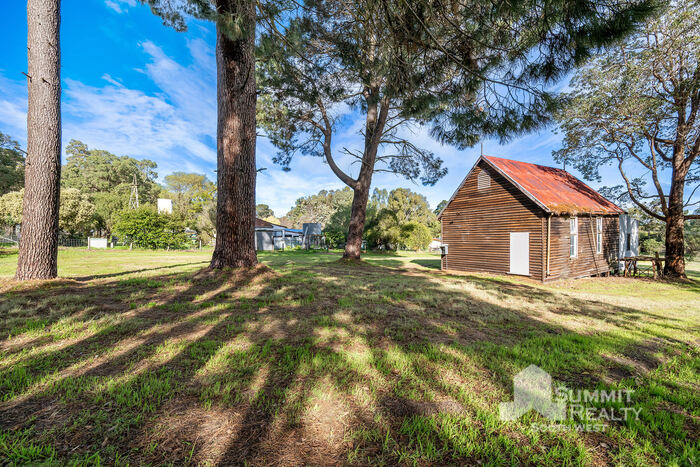
Now: 2026
Built in 1907, this heritage-listed timber church sits on a 4,015m² block in the heart of Cookernup, surrounded by mature pines and gums, ready for someone to give it a new life. It's now sold, and it's going to someone with a plan to give it that new life.
For 118 years, Holy Trinity Anglican Church has stood at the heart of Cookernup, through the timber boom, wars, drought and generations of baptisms, weddings and funerals. It is, quite simply, one of the most character-filled small buildings left in the Shire of Harvey: a single-storey timber-framed church with weatherboard cladding, a gabled corrugated iron roof, and the kind of hand-built detailing that hasn't been made this way in a hundred years.
The building has recently had all asbestos-containing material removed, and now sits as an honest, stripped-back shell. Original timber lining, sash windows and roof trusses are all exposed, ready for a new owner to write the next chapter. Set on a generous 4,015m² block among mature pines, gums and grassland, with the original school, hall and townsite fabric of old Cookernup still visible nearby, this is a genuinely rare offering.
It's not a project for everyone. It's heritage listed and has no services connected, so it takes a particular kind of buyer. But for the right person, someone drawn to a private residence with real soul, a striking function or gallery space, a community use, or simply the custodianship of an irreplaceable piece of history, 145 Salisbury Road offers something no display home ever could.
A historical photograph of Holy Trinity Church, alongside its condition today. Click any photo below to view it full size.
Understanding the history behind this site is part of understanding what it's worth protecting, and what makes it special.
Bindjareeb and Wardandi Noongar people are the traditional custodians of the Harvey region, with connections to this land and its waters spanning over 45,000 years, a connection that continues today.
Stephen Henty and Thomas Peel are recorded as the first Europeans to visit the area, guided through the Harvey River reaches by Bindjareeb and Wardandi Noongar people, the traditional custodians of this Country.
Joseph Logue arrives with his extended family in search of farming land, taking up a 9,000-hectare grant on Bindjareeb and Wardandi Noongar boodja he named "Kookernup," the origin of the town's name, from a Noongar word associated with the swamp hen.
The Cookernup townsite is officially gazetted in August 1894, within the Wellington Land District, the same subdivision this property was carved from.
Cookernup develops rapidly as timber milling escalates in the district. A post office, school, railway station and hall are all established, and for a time Cookernup's population outstrips nearby Harvey.
The church is built in the latter part of 1907 and formally opened on 2 February 1908. The Bishop of Bunbury, Rt Rev Frederick Goldsmith, dedicated the church on opening day, and the press reported the "sacred building was crowded with a very attentive congregation."
A porch was added in 1913, renewed in 1952, and replaced in 1963 with a larger porch clad in fibre cement (asbestos). New altar rails were installed in 1959, when the church interior was also relined in asbestos sheeting.
As the only church in Cookernup, Holy Trinity has hosted generations of local baptisms, weddings and funerals. It has been the social heart of the town for well over a century.
All asbestos-containing material has been removed from the building. It's now being now sold, with the vendor looking for a buyer who will give this heritage landmark a sympathetic new future.
I acknowledge the Bindjareeb and Wardandi Noongar people as the traditional custodians of this Country, and pay respect to their Elders past and present. History compiled from the Shire of Harvey Municipal Heritage Inventory / Local Heritage Survey entry for "P1197 Holy Trinity Anglican Church" (via the State Heritage Office's inHerit database), the Shire of Harvey's Aboriginal Culture page, and public historical sources on Cookernup and the Wellington Land District. If your family has photographs, records or memories of the church or town, I'd love to hear from you. Get in touch.
Holy Trinity Church is included on the Shire of Harvey's Local Heritage Survey and its Local Planning Scheme No. 2 Heritage List, as "P1197 Holy Trinity Anglican Church". Here's what that means in plain English, drawn directly from the Shire's published heritage policies.
The Shire's planning scheme classifies land uses with a simple code, useful to know before you make an offer. P = permitted outright if it meets standard requirements. D = discretionary (the Shire can approve it, but must first grant development approval). A = discretionary and must be advertised for public/neighbour comment before a decision is made. X = not permitted in that zone. This lot is zoned Rural Residential under the Shire of Harvey's LPS2. Before purchasing, buyers should still request a Planning Certificate from the Shire of Harvey (see contact details below) to confirm exactly which uses are P, D, A or X on this land.
Buildings like this one are commonly repurposed, subject always to a development application, as a striking private residence (a "repurposed dwelling" in planning terms), a function, wedding or event venue, an art studio, gallery or creative workspace, a small café, cellar door or community hub, or by continuing as a place of worship or community meeting space. Every one of these ideas needs to be tested against the heritage requirements for this specific lot before you commit, and that's exactly what the Shire's Planning Services team, or your own town planner, can help you with.
Shire of Harvey Planning: (08) 9729 0300Thanks to everyone who inspected and put in an Expression of Interest. If you missed out, or you're after something a bit different in the area, give me a call or have a look at what's coming up off-market.
Everything Ben has been given, shared openly so you can do your own homework.
Ben would rather answer your questions directly than have you guess. Call, text or email any time.